
"We Can Literally See Her Go From Tense and Uncomfortable to Melting in Berni's Arms"
One family's journey through feeding difficulties, laryngomalacia and finding comfort through multidisciplinary care.
As healthcare professionals, we often explain conditions from a clinical perspective. We talk about anatomy, discuss research and outline treatment options. Whilst that information is important, it can never truly capture what it feels like to be the parent living through it every day.
I would like to say a heartfelt thank you to one very special mum who has generously shared her family's story. By opening up about their experience, she hopes to help other parents who may be searching for answers, questioning their instincts or simply needing reassurance that they are not alone. This article has been written together, combining her words with my perspective as a principal osteopath, and I am incredibly grateful for her willingness to share such a personal journey.
Before reading Melissa’s story, it is helpful to understand a little about laryngomalacia.
What is laryngomalacia?
Laryngomalacia is the most common cause of noisy breathing in babies. The tissues above the voice box are softer than usual, meaning they can fall inwards slightly during breathing. This often creates a characteristic squeaking or noisy breathing sound known as stridor, particularly when a baby is feeding, crying, excited or lying on their back.
For many babies, laryngomalacia improves naturally as they grow and the airway matures. However, whilst the condition itself often resolves with time, it can make feeding much harder. Babies may need to work significantly harder to breathe whilst feeding, tire quickly, struggle with reflux or become distressed because something that should come naturally feels like hard work.
It is important to be clear that osteopathy does not treat laryngomalacia. Emma remained under the care of her medical team throughout her journey. My role was to help manage the muscular tension that had developed as her little body worked so hard to breathe and feed. As part of a wider multidisciplinary team, the aim was simply to help reduce her tension, feel more comfortable and feed better as a result.
The story below is told in Emma's mum's own words.
As a first-time mum, what did you wish someone had told you?
I wish someone had told me to trust my instincts.
As a first-time mum, I put a lot of Emma's symptoms down to being normal. I'd often Google different things and ask whether they were typical for newborns, and more often than not the answer was yes. But deep down, I knew something wasn't quite right.
Everyone reassured me that babies cry, breastfeeding is difficult and I'd learn to soothe her. Whilst all of those things can absolutely be true, my gut kept telling me Emma was uncomfortable, not just unsettled.
Looking back, I spent so much time worrying that I was simply being an anxious first-time mum. Now I realise I wasn't anxious, I was trusting my instinct.
As an osteopath, one of the most valuable things I have learnt is that parents know their babies incredibly well. Clinical assessment is always essential, but parents are often the first people to recognise when something simply doesn't feel right. Listening to those concerns is an important part of good healthcare, and as I truly believe - mother’s instinct must be taken into consideration.
Looking back, what were the early signs?
From the moment Emma was born, we struggled with breastfeeding. Every attempt to latch would often end with both of us in tears. She would scream as soon as we tried to feed, and it was heartbreaking.
She was also incredibly stiff. From day one she could lift her head, and before long she was rolling over. Like many parents, I assumed this meant she was strong or ahead of her milestones. Looking back, we learnt that in Emma's case these movements may have been linked to the amount of tension she was carrying. Of course, every baby develops differently, but for us it was one of the pieces of the puzzle.
Emma also preferred certain positions, was often unsettled and seemed uncomfortable much of the time.
Another thing we noticed from birth was her breathing. She was a very noisy breather, often snored when asleep and made a squeaking sound, particularly when feeding, crying or lying on her back. We later learnt this sound is called stridor, and it turned out to be one of the key signs of her laryngomalacia.
Many of these signs can occur individually in otherwise healthy babies, which is why they can be difficult to piece together in the early days. It was the combination of Emma's symptoms, together with further assessment and investigation, that eventually led to the diagnosis.
You mentioned that some professionals felt Emma's symptoms were normal. Why didn't you stop after seeing the first professionals?
Every professional we met genuinely wanted to help us, and every single one played an important part in our journey.
Like many newborn behaviours, a lot of Emma's symptoms could be explained individually, and we were often reassured that she would grow out of them. But as a mum, I couldn't shake the feeling that there was more going on.
It wasn't until I attended a mums' group called Connected Parents run by lactation consultant Jo and doula Sarah that Jo assessed Emma and immediately commented on how tight her jaw felt. She suggested seeing Berni, and that became another important piece of the puzzle.
Looking back, I'm incredibly grateful that different professionals viewed Emma through different lenses. No one person had all the answers, but together they helped us understand what was happening.
This section perfectly illustrates why multidisciplinary care is so valuable. Lactation consultants, health visitors, GPs, paediatricians, ENT specialists, osteopaths and feeding specialists all bring different knowledge and experience. It is often those combined perspectives that provide families with the answers they need.
How did receiving a diagnosis of laryngomalacia change your understanding?
Receiving the diagnosis suddenly explained so much.
Emma had been working incredibly hard every single day just to breathe and feed. Looking back, it made sense that her little body was holding so much tension.
Osteopathy didn't treat Emma's laryngomalacia, but helping to reduce the tension she was carrying made feeding and day-to-day life so much more comfortable for her. At first I was able to feed successfully using a nipple shield, and after further treatment we gradually managed to feed without one at all.
Whilst watching your baby struggle every day is incredibly difficult, finally having a diagnosis brought an enormous sense of relief. It meant I wasn't imagining things or overreacting, it gave us answers and allowed us to build the right team around Emma so we could support her in the best possible way.
What was the hardest part emotionally?
Without question, it was constantly questioning myself.
I worried that I was overreacting or simply didn't know what I was doing because I was a first-time mum. Every reassurance that "it's normal" made me question my instincts a little more.
One moment that has always stayed with me happened during one of Emma's hospital admissions. I was completely overwhelmed and upset about feeding, and a student midwife simply sat with me whilst I cried. She listened, reassured me and made me feel heard.
She probably doesn't realise how much that meant, but I still think about her kindness now.
Sometimes it's not just the diagnoses or treatments that make the biggest difference, it's the people who take the time to remind you that you're doing your best.
As healthcare professionals, this is perhaps one of the biggest reminders we can take from Emma's story. Clinical knowledge is essential, but compassion, listening and making families feel heard can be just as powerful.
What does laryngomalacia look like in daily life now?
Laryngomalacia is still very much part of our daily lives.
Emma has noisy breathing and often has to work incredibly hard to feed. She frequently comes off the breast to catch her breath and will sometimes cough or splutter during feeds. She also struggles with reflux and can become upset very quickly when she's uncomfortable.
We've also learnt to recognise when her body is becoming tense again. Feeding becomes more difficult, she feels much stiffer and generally seems more uncomfortable. Regular osteopathy has become one of the ways we help manage that tension alongside all of the medical support she receives. We can literally see her go from tense and uncomfortable to melting in Berni's arms.
There are definitely good days and difficult days, but we're learning what Emma needs and celebrating every little step forward.
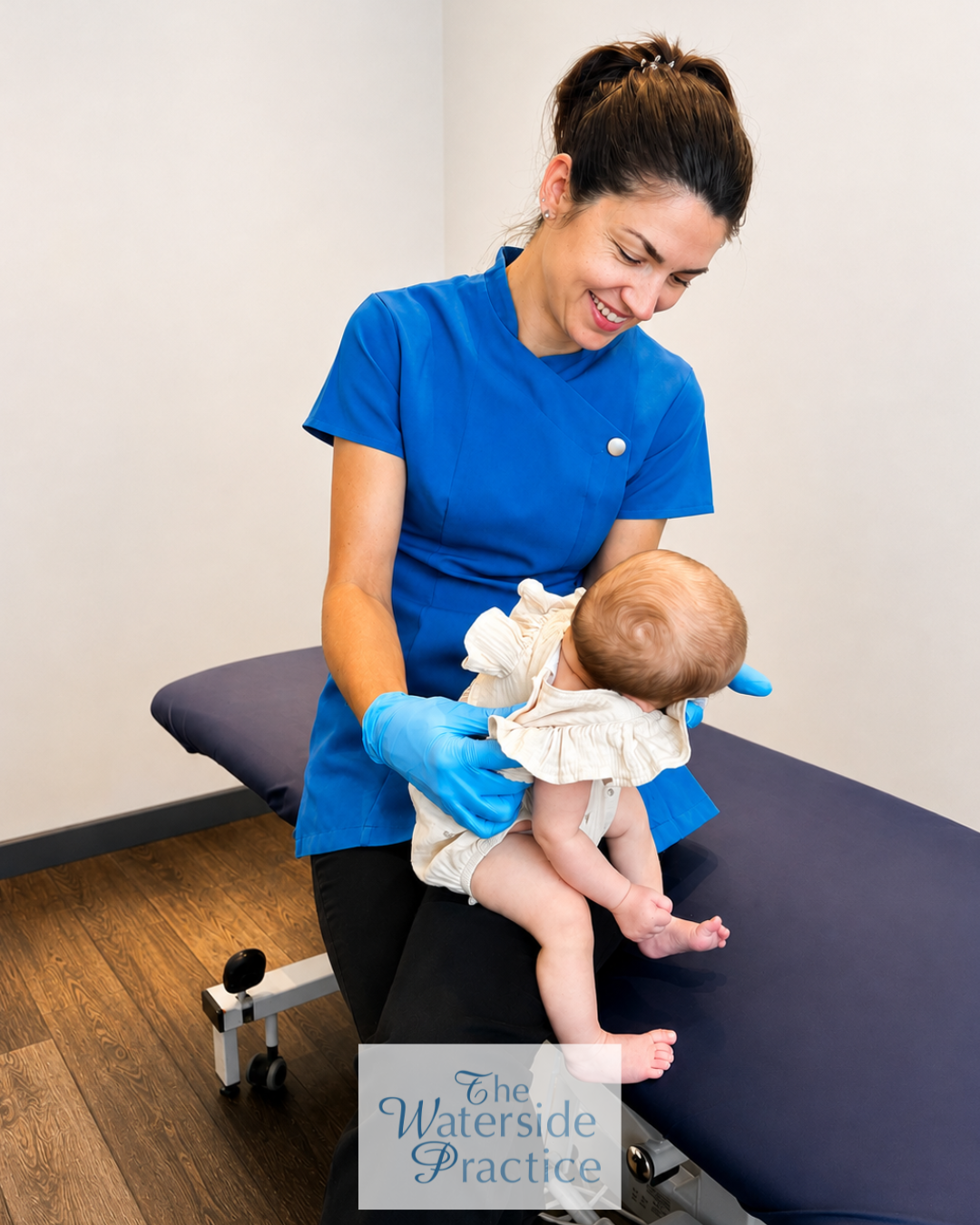
A quiet moment during a recent treatment, as Emma relaxed enough to fall asleep in Bernitta's hands.
What's Emma like now?
Emma is such a happy, determined little girl.
She still has laryngomalacia, and some days are definitely harder than others, but she's also thriving. Feeding is so much easier than it was in those early weeks, she's growing beautifully and her personality is really starting to shine through.
Looking back at those first few weeks makes me realise just how far she's come, and that gives us so much hope for the future.
What's one piece of advice you'd give to parents experiencing something similar?
—>Trust your instincts.
Don't be afraid to ask questions or even seek another opinion if something doesn't feel quite right. That doesn't mean you're doubting professionals, it simply means you're continuing to advocate for your child.
—>Find your team.
For us, that's looked different at different stages. We've had incredible support from our family, lactation consultants, Berni, feeding specialists, health visitors, the hospital team, ENT specialists and consultants. Every one of them has played an important role in helping Emma.
No single person had every answer, but together they helped us understand our daughter and support her in the best possible way.
Asking for help doesn't make you any less of a parent. If anything, it's one of the bravest things you can do.
Final thoughts
When I first met Emma and her mum, the challenges they were facing were immediately clear. Like everyone else involved in Emma's care, my role was simply one piece of a much bigger picture. Supporting babies with feeding difficulties is rarely about one professional or one treatment. It is about bringing together the right people, at the right time, to support both the child and their family. I am always grateful for the wider community of support in those early stages after birth, from lactation consultants and expert midwives who direct patients to our treatment room as osteopaths.
Emma's story is a wonderful example of that. It reminds us that whilst diagnoses matter, listening matters just as much. Trusting a parent's instincts, recognizing when something doesn't quite fit, and working together across different professions can make an enormous difference to a family's journey.
Finally, I would like to thank Emma's mum once again for allowing me to share such a personal chapter of their lives. Her honesty, courage and willingness to help other families is something I deeply admire. I have no doubt that another parent reading her words will recognise themselves in this story, feel reassured that they are not alone and perhaps find the confidence to keep asking the questions that lead them to the right support.
Sometimes, the most powerful thing we can offer another family is hope. And as a professional I am truly honored to provide help along the journey.